
The Image Returns

Michael Jackson is in the air.
The film. The music returning through open windows and spring playlists. The voice comes back — and with it, everything the voice carried: joy, strangeness, spectacle, grief. The most famous face in the world refusing to stay fixed.
Jackson was always a shapeshifter. That was both his gift and his burden.
The image changed constantly. The mythology only deepened.
⸻
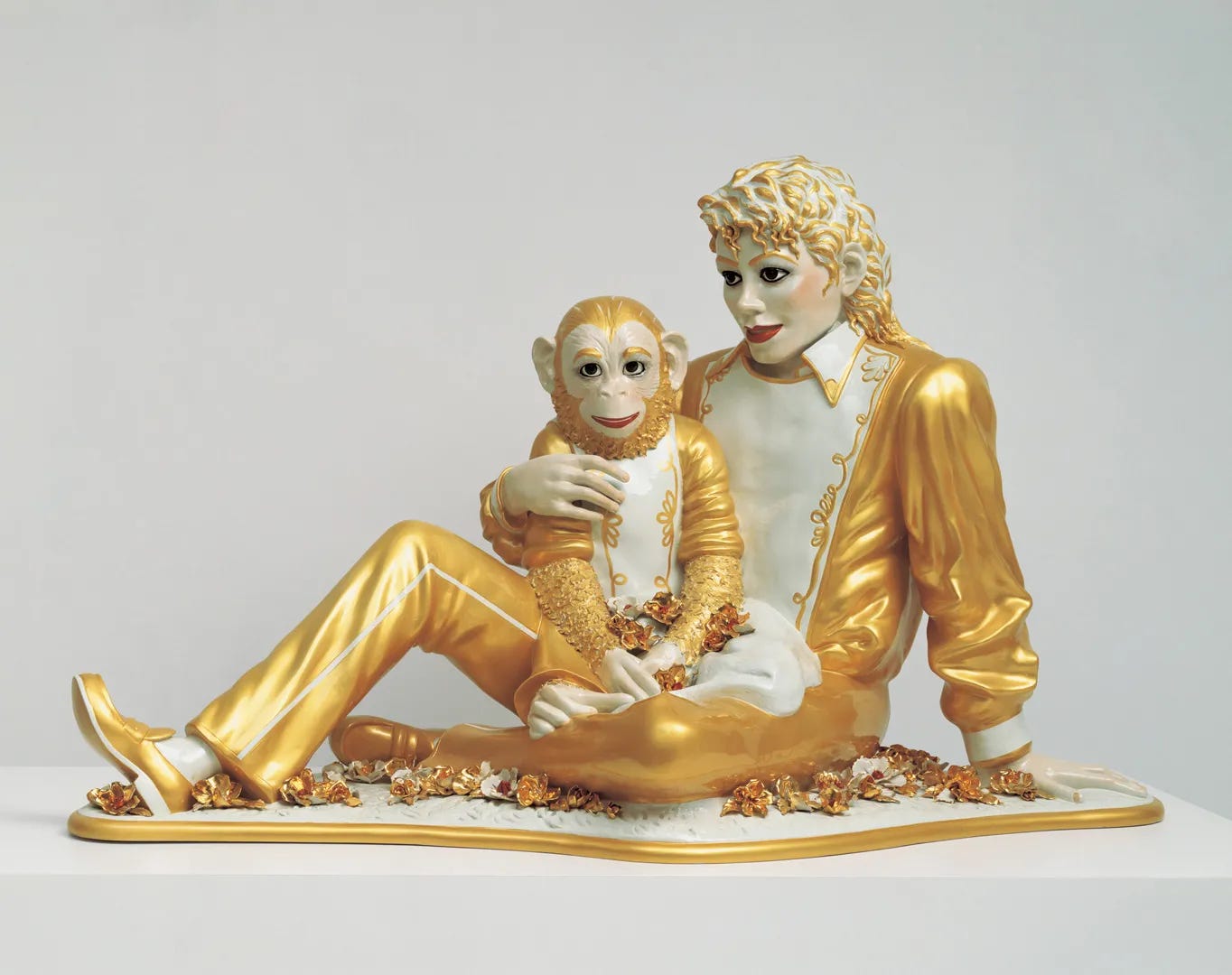
Jeff Koons, Michael Jackson and Bubbles, 1988; photo courtesy of the artist and The Broad Museum, Los Angeles
⸻
The Met Gala was the talk of New York this week.
Bodies on the steps became citations — paintings, movements, ghosts of other bodies entirely. Most of it was costume. Some of it was something else.
Madonna arrived as a painting by Leonora Carrington — not wearing a reference so much as inhabiting a world. A ship balanced on the hat, grey tulle held wide by attendants, a gold horn in hand. Surrealism not as style but as condition.
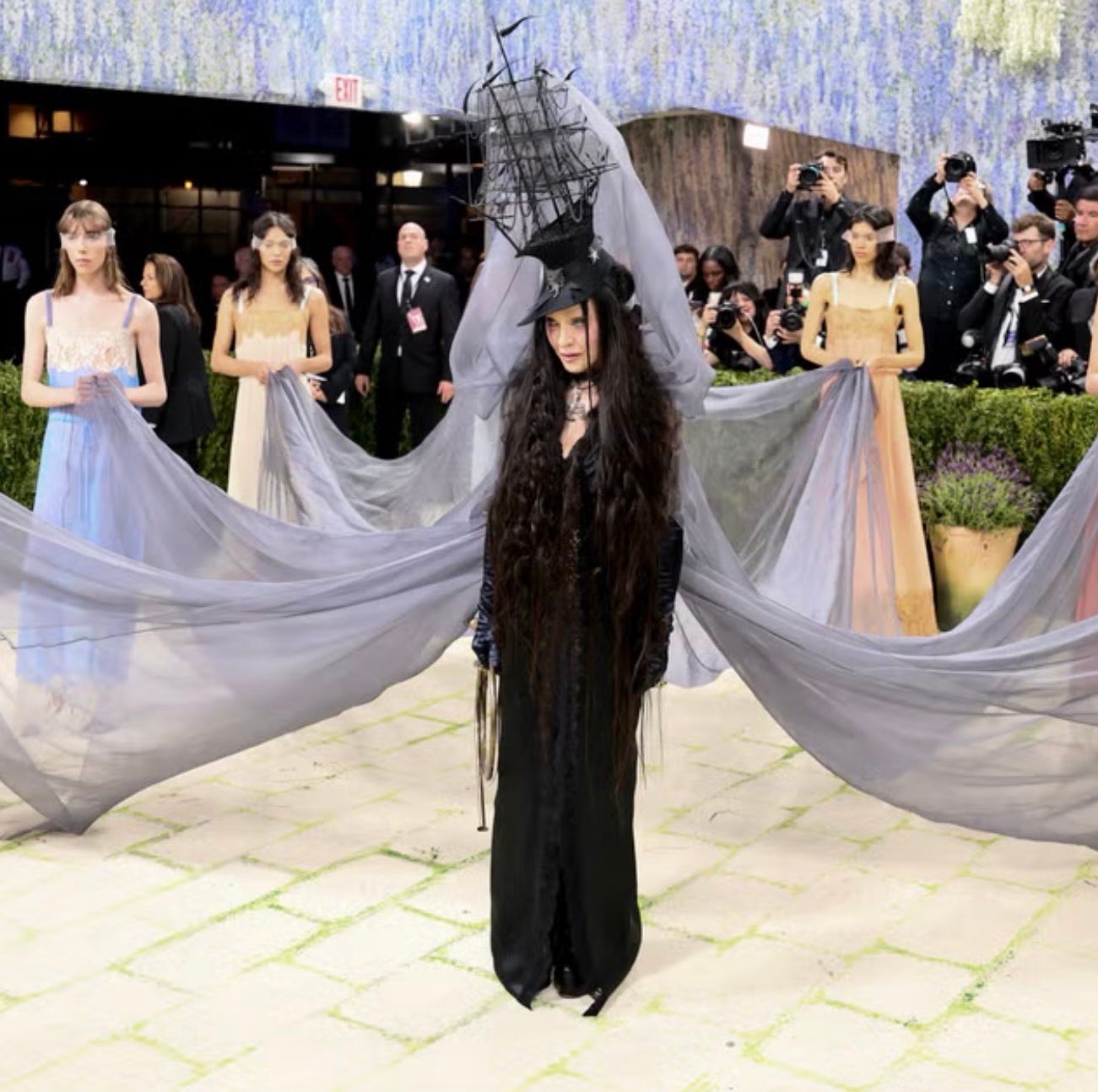
Madonna at the Met Gala, 2026; photo: Getty Images
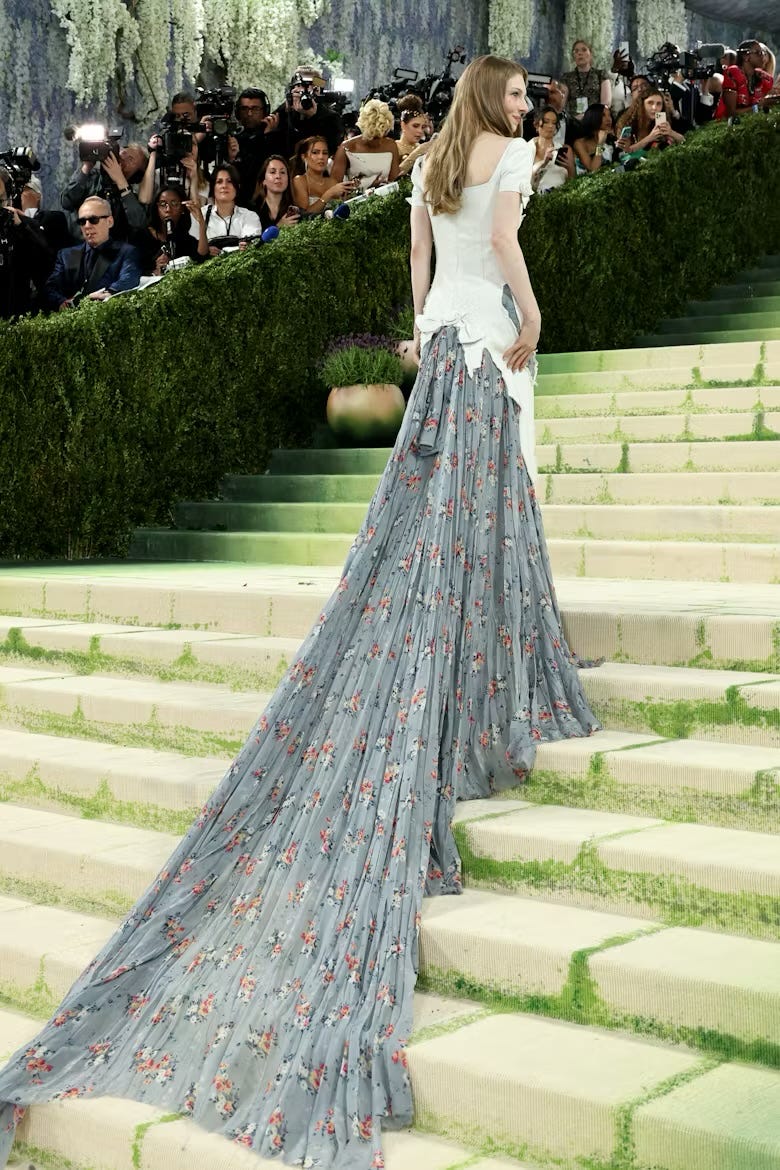
Hunter Schafer came closest to absorbing the boundary altogether. The custom Prada dress appeared almost excavated rather than constructed — delicate floral fabric emerging through tears and openings, as though a Viennese portrait had aged, frayed, and stepped out of the canvas intact. As she moved up the staircase, the train seemed to merge into the interior itself. Moss, flowers, pale greens extending the garment into atmosphere. Klimt’s Mäda Primavesi, filtered through the ghost of Emilie Flöge, made newly strange.
Fashion has always understood transformation intuitively. The body becomes image, then re-emerges altered.
Art has been asking the same question longer.
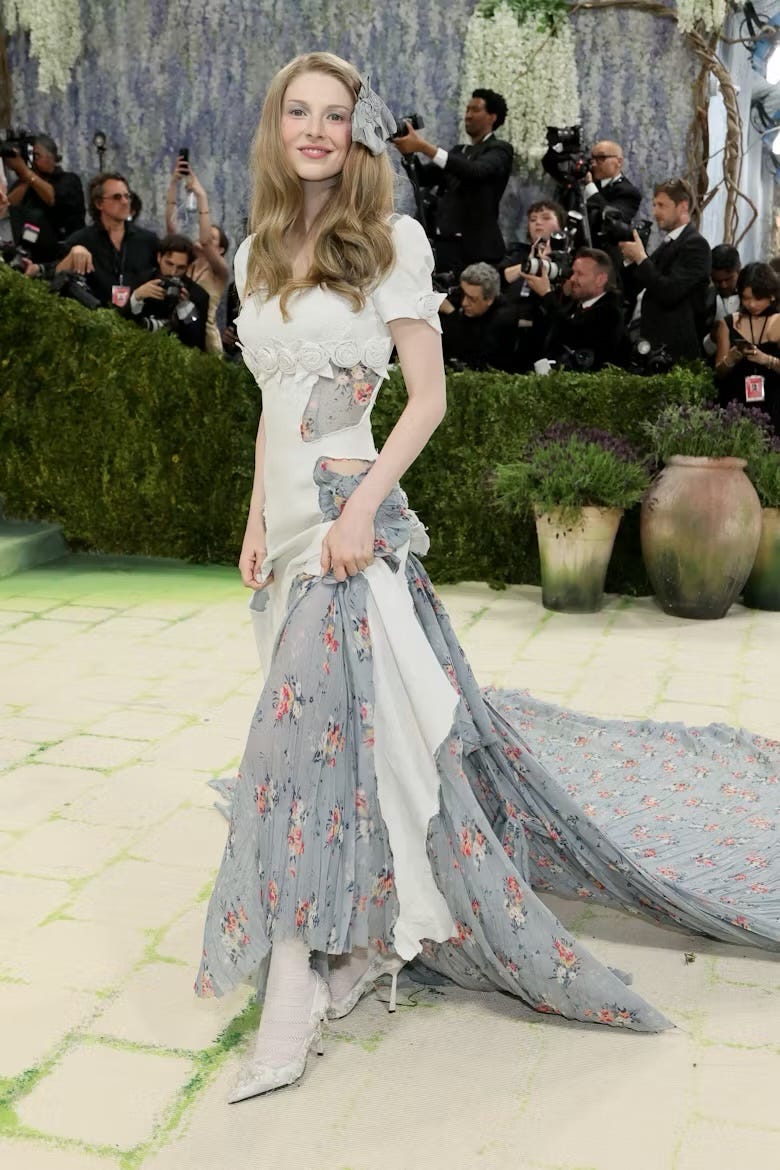
Hunter Schafer in Prada at the Met Gala, 2026; photo: Getty Images
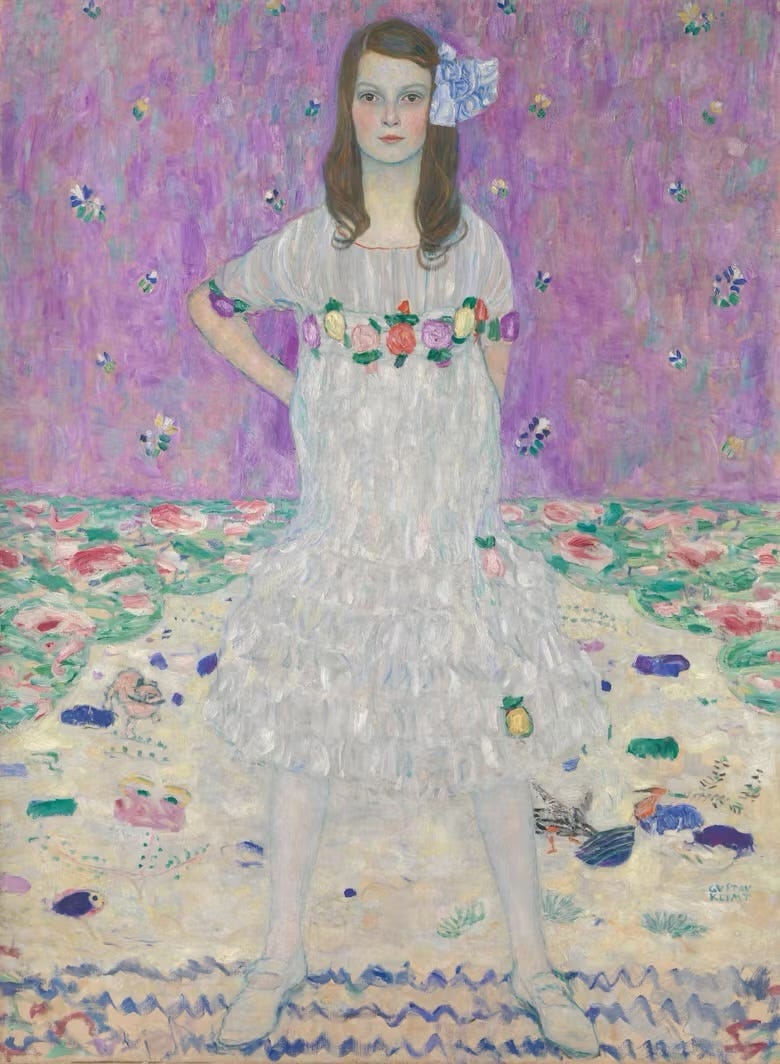
Gustav Klimt, Mäda Primavesi, 1912
L.H.O.O.Q. (photo: Getty images)
⸻
At their new Madison Avenue ground-floor gallery, Gagosian presents a tightly focused Duchamp exhibition. A larger survey runs concurrently at MoMA, but the restraint here sharpens the point.
A bicycle wheel mounted on a stool. A shovel suspended from the ceiling, its shadow more present than the object itself. Air de Paris — an invisible city transformed into object. L.H.O.O.Q. and L.H.O.O.Q. rasée — the mustache shaved away, the joke somehow sharpened by its absence.
This is where the terms changed.
Not painting. Not sculpture. A chosen object transformed through selection, framing, designation. The concept became the work. The joke did too.
The readymade destabilized authorship, originality, permanence. Meaning itself could suddenly shift through framing, context, gesture.
Nothing fixed. Everything that followed lives, in some way, inside the space Duchamp opened.
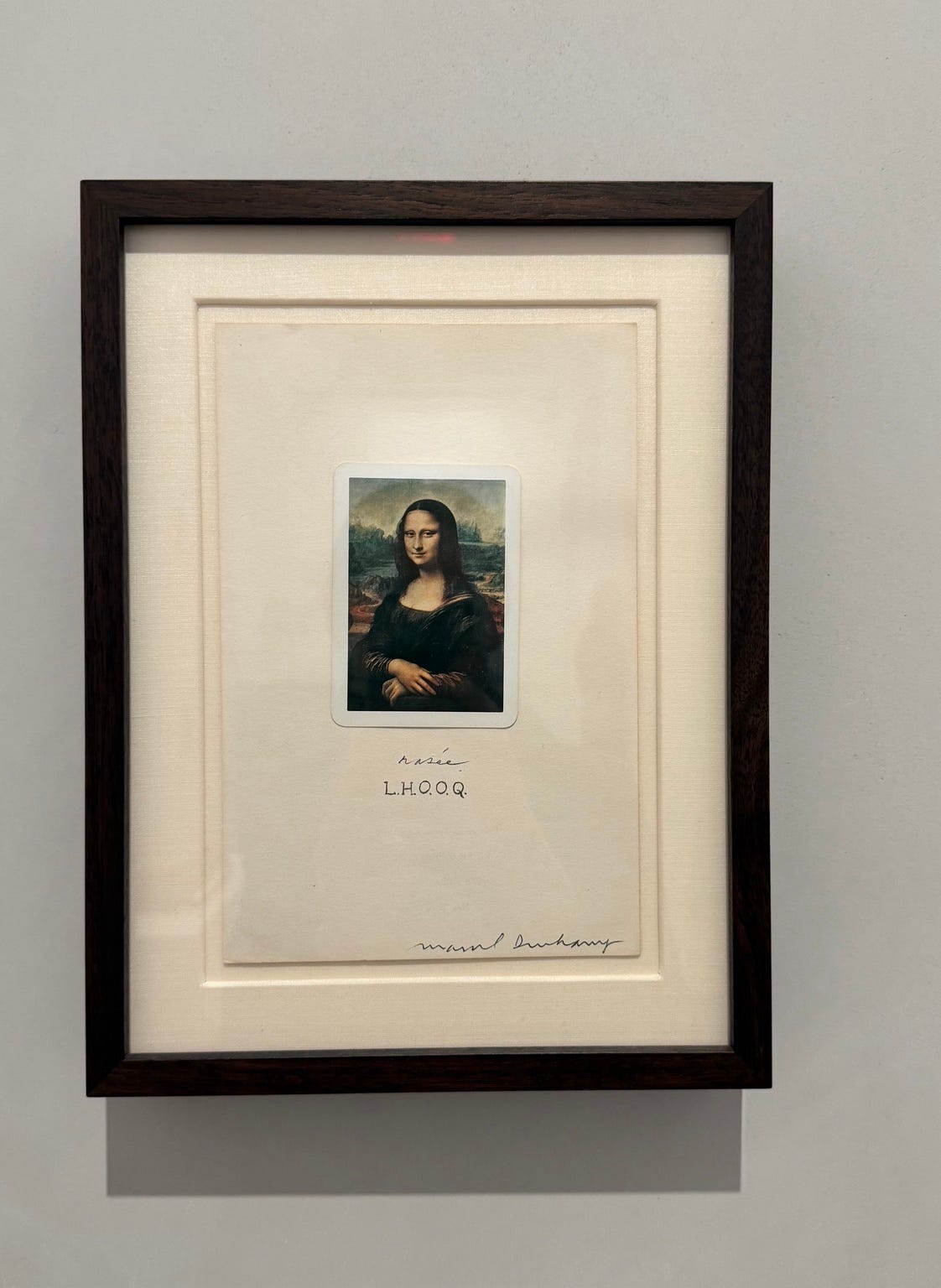
Marcel Duchamp, L.H.O.O.Q. rasée, 1965
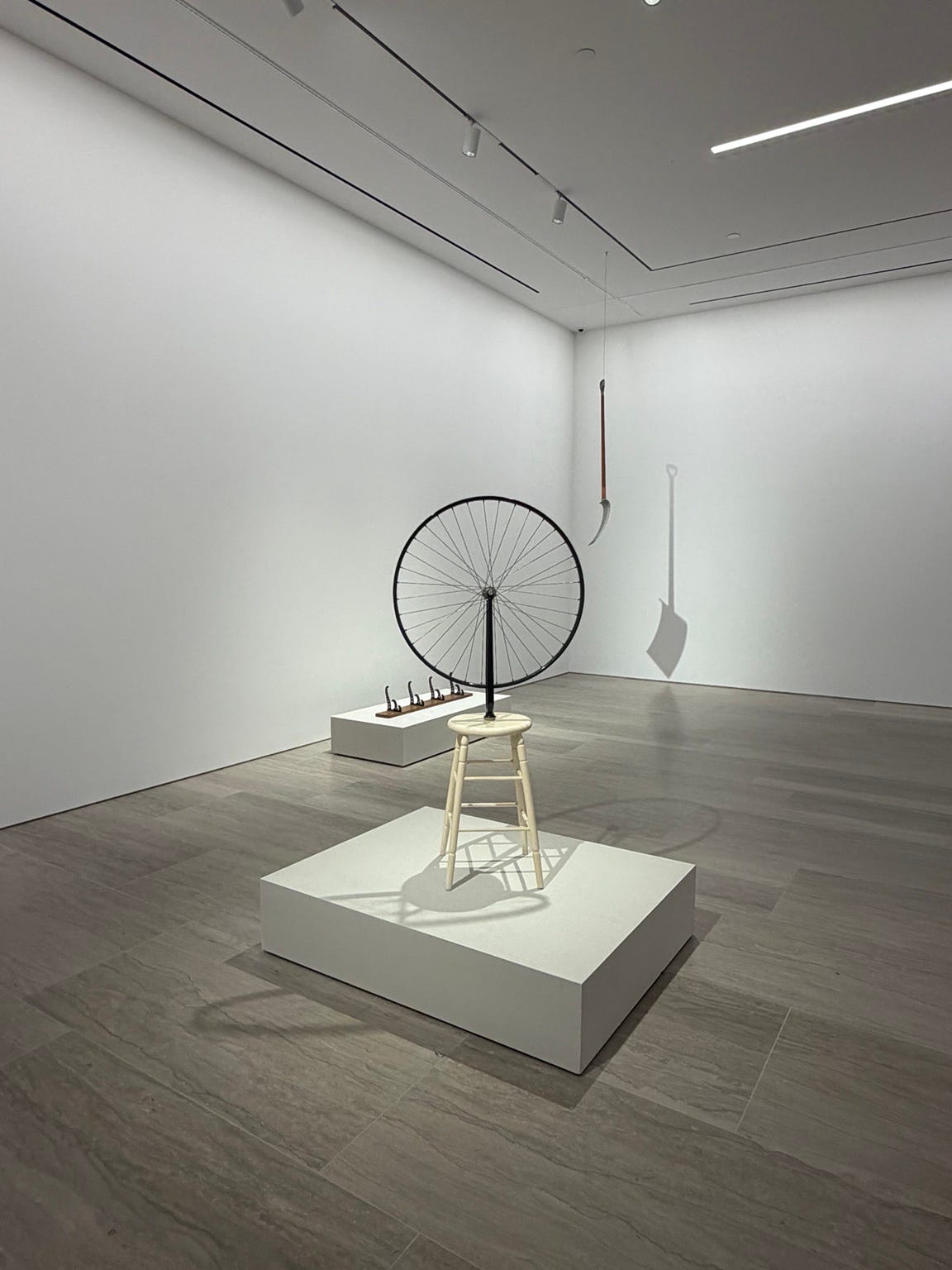
Marcel Duchamp at Gagosian
⸻
At White Cube: David Hammons and Jannis Kounellis. One of the strongest shows in New York right now.
Many of the works cite Duchamp directly, some more explicitly than others. Untitled (wine bottles), 1989 — a bottle wheel assembled from Night Train bottles — riffs on Duchamp’s Bicycle Wheel while transforming it entirely. Where Duchamp drained the object through detachment, Hammons reloads it with sociology, economics, memory, survival.
The readymade, but inhabited.
Nearby: a framed letter from someone longing to own one of the artist’s snowballs but unable to afford one. Adjacent, a bowl of water mounted on the wall.
A melted snowball? An evaporated gesture? Holy water?
When we invest in art, what are we actually buying — an object, a mythology, proximity to art history itself?
Duchamp bottled Paris air and called it art. Hammons sold snowballs on the street. The story became the legend.
In the body prints, Hammons turns Yves Klein’s Anthropometries inside out. Grease replaces paint. The works feel less like impressions than reversals — traces of the body resisting visibility even as they insist upon it.
I remember visiting Hammons’ Yonkers studio years ago. Gesturing toward a recent tarp work, he compared it to a Yohji Yamamoto dress. The canvas, like a body, protected and concealed at once.
Surface. Shadow. Disguise.
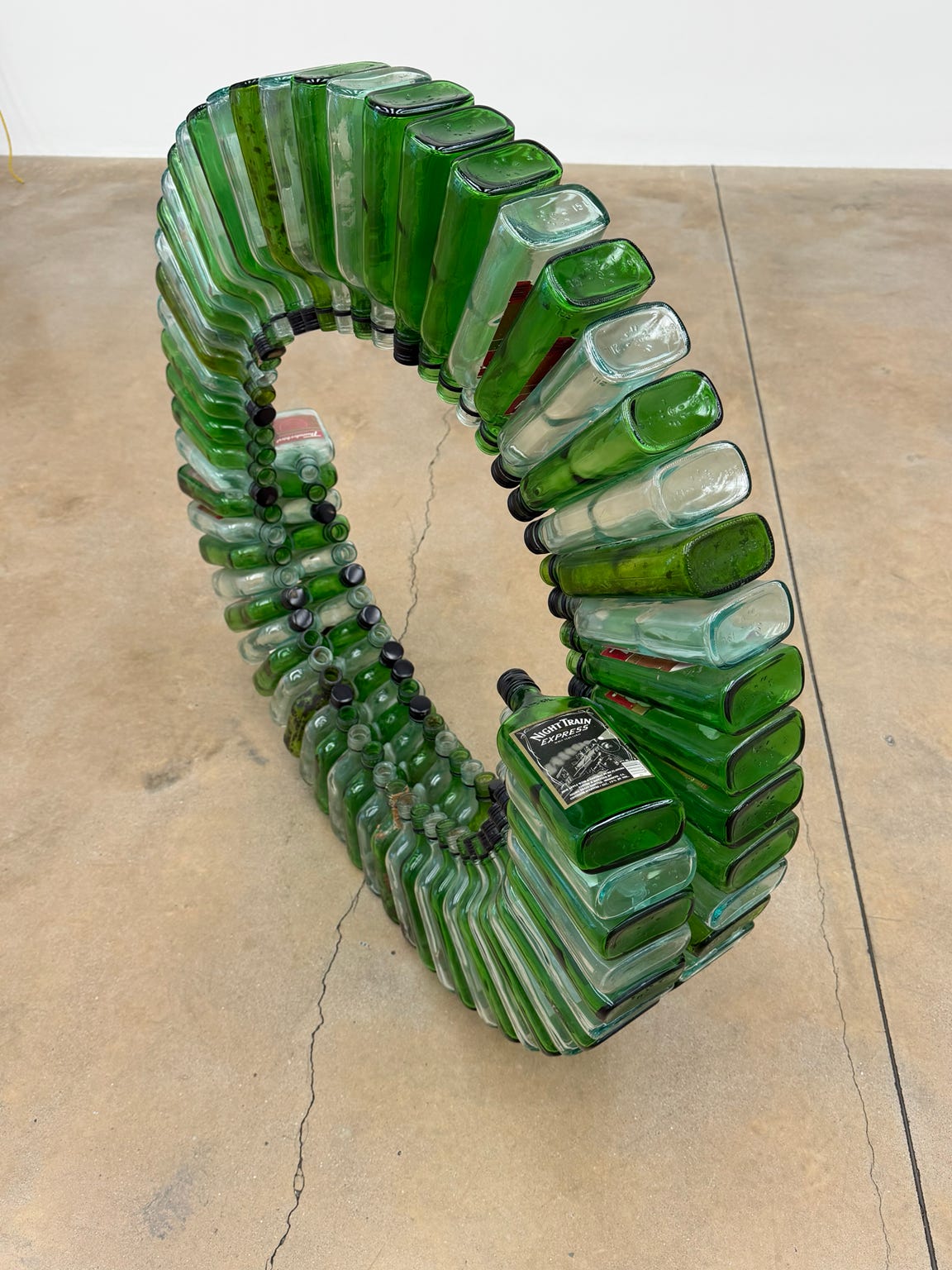
David Hammons, Untitled (wine bottles), 1989
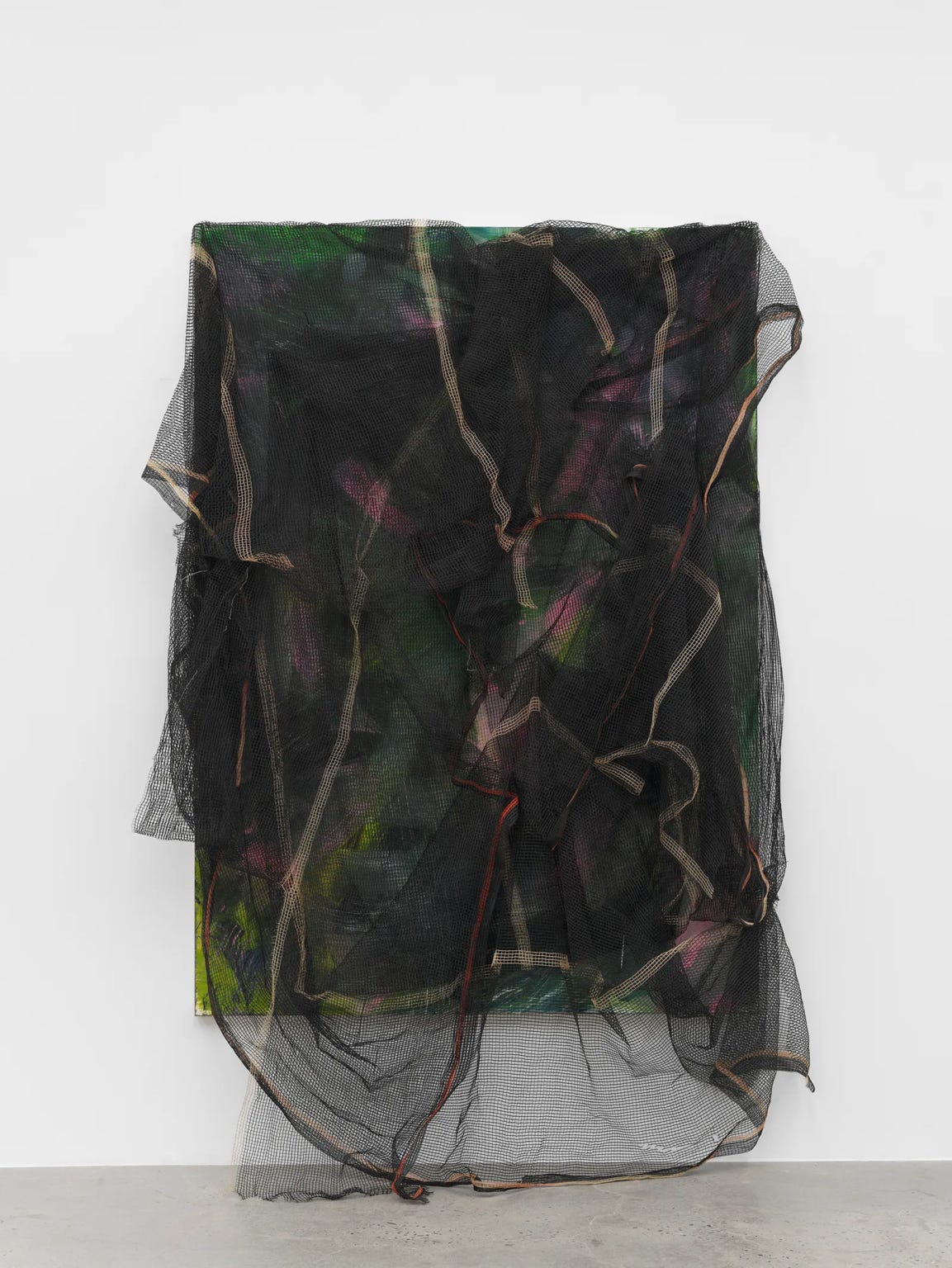
David Hammons, Untitled, 2014–16
⸻
At Marian Goodman, Julie Mehretu.
Our Days, Like a Shadow (a non-abiding hauntology) unfolds across three floors and pushes painting into increasingly unstable territory — materially, spatially, perceptually.
The new black paintings begin from darkness rather than against it. Light doesn’t simply strike the surface; it emerges from within — refracting, dissolving, absorbing back into shadow as you move through the galleries. Figure and field refuse to fix. Opacity and illumination trade places.
The TRANSpaintings, made in collaboration with sculptor Nairy Baghramian, abandon the wall altogether. Suspended in aluminum structures, translucent mesh paintings can be approached from either side. Light passes through them. Your own movement becomes part of the image.
The works never fully settle. Neither entirely painting nor sculpture. Neither image nor abstraction.
You have to hold the darkness long enough for the light to emerge. You move around them rather than simply stand before them. Duration, perspective, movement — these aren’t incidental. They’re the work.
References accumulate — John Coltrane, Jack Whitten, Édouard Glissant, Buddhist notions of non-abidance — but nothing collapses into illustration. The paintings remain open systems: absorptive, unstable, constantly revealing.
Like Hammons. Like Duchamp. Like Jackson.
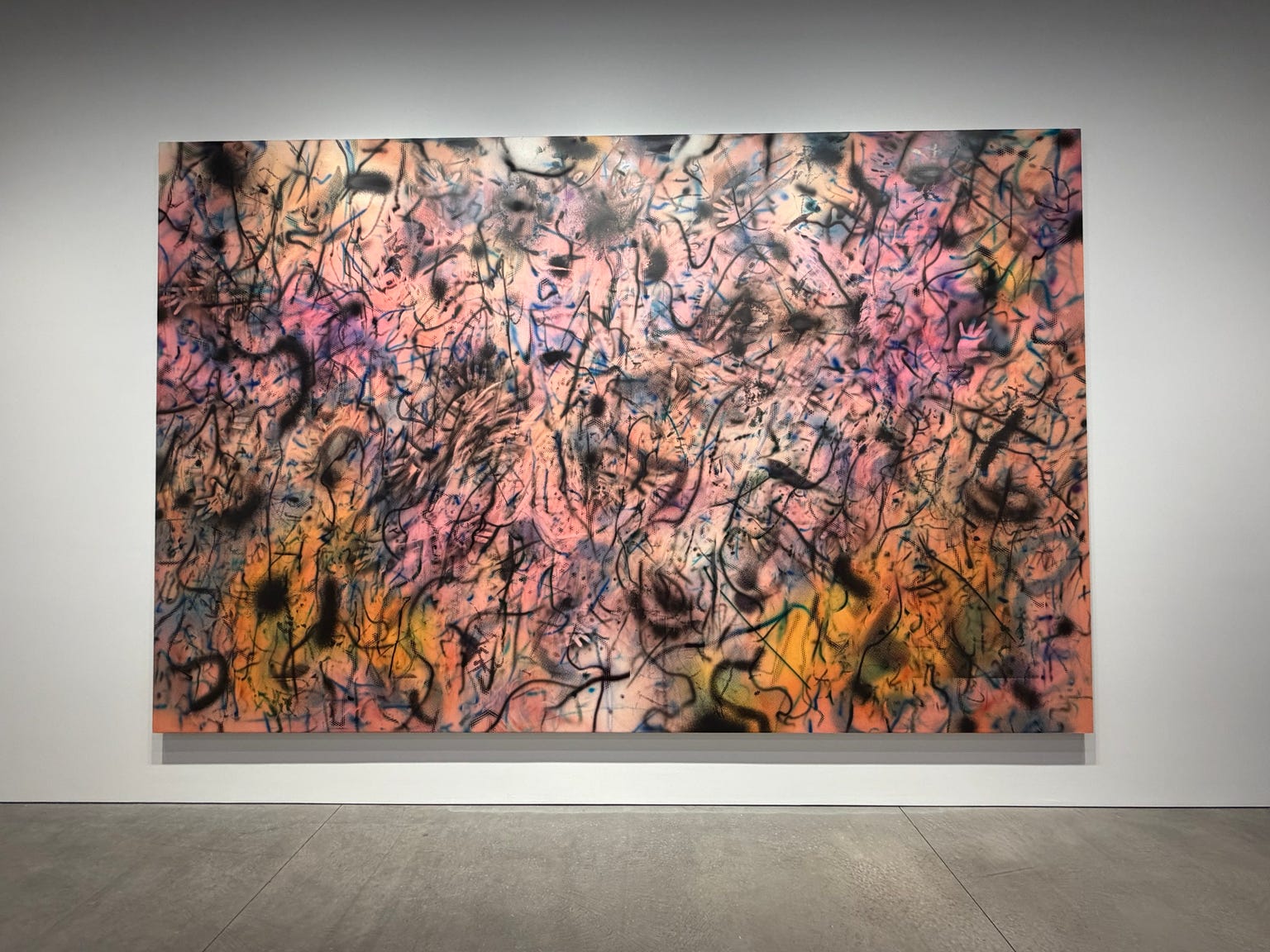
Julie Mehretu, Our Waste Places, 2024–2026
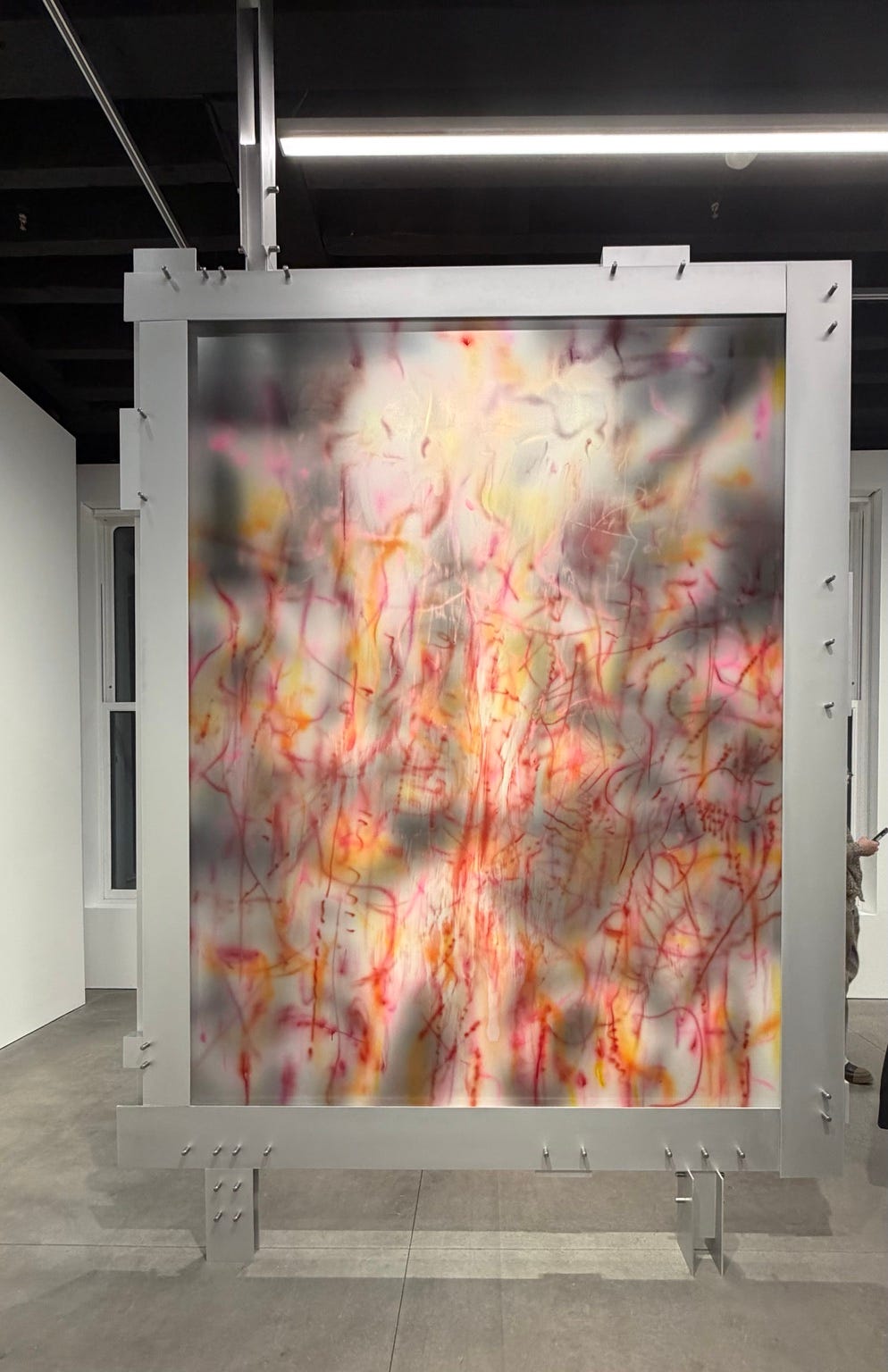
Julie Mehretu / Nairy Baghramian, TRANSpaintings (gay guerrilla) / Upright Brackets, 2024
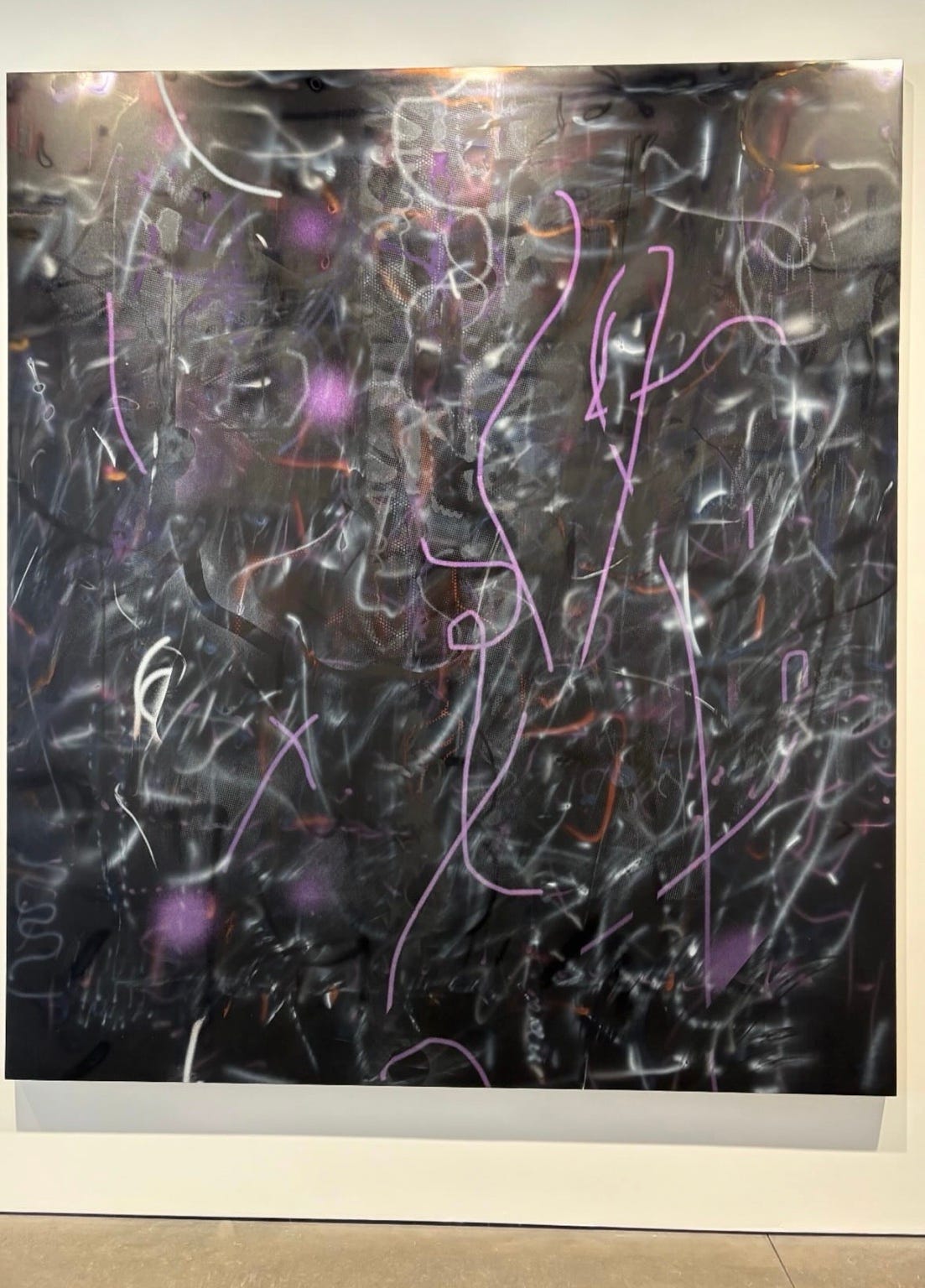
Julie Mehretu, Inside Totality (what the ground cannot hold), 2025
⸻
This is what great work does.
It carries history absorbed into the surface without being reduced to it. It changes depending on where you stand, what you bring, what the light is doing.
Music does this too.
The voice returns through the speakers and you can no longer locate the original source. You simply feel it returning — altered, carrying everything it has been.
The shapeshifter who never fully arrived and never fully left.
The image returns.
The work remains.
The story goes on.
⸻
Playlist
A soundtrack for the image refusing to stay fixed.
Wonderful as always 👍👍👍👍👍